
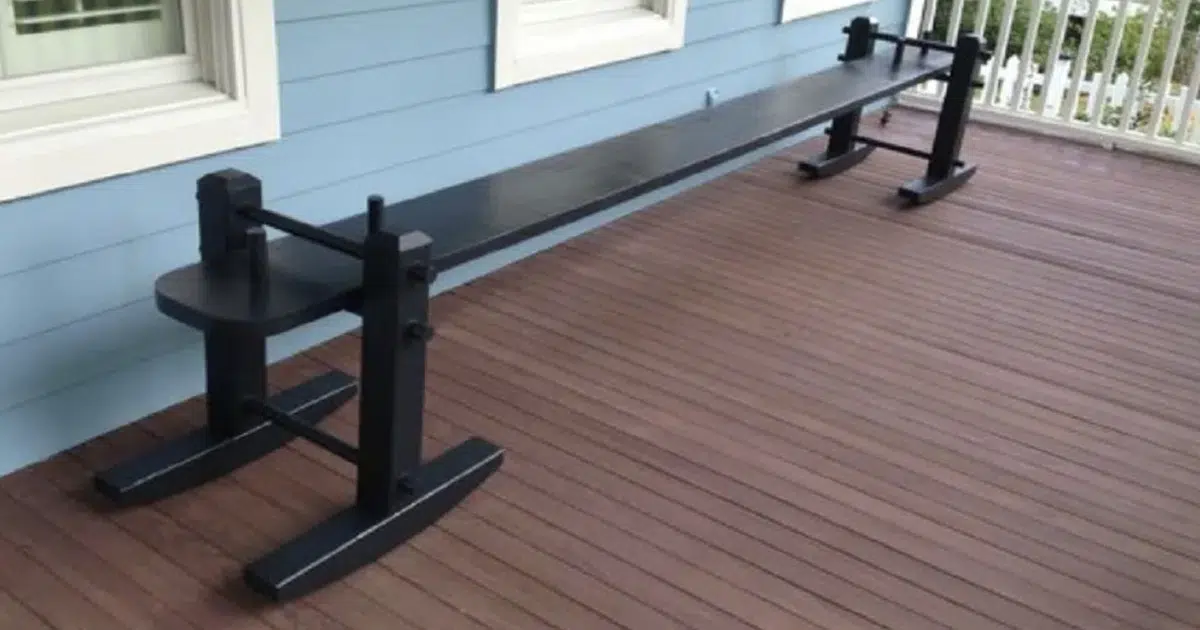
Ever find yourself on a stroll through one of those Southern neighborhoods where the air around you just feels kinda… syrupy? Not just because you’re sweating—make no mistake about it, it is always sweating-level hot in the South—but really that slight, unexplainable difference that you can just notice. You’re walking by an old home with a nice wraparound porch, trailing ivy, and then you see it: this long, bouncy bench thing. Like a porch swing and a balance beam had a child. That is a joggling board.
The thing is, most people have absolutely no idea what they’re looking at the first time. It doesn’t look comfortable at all, and it seems like it just wobbles, even if you just breathe on it. But ask around—especially in Charleston or a place with strong porch culture. Someone will invariably tell you a story involving Scotland, sore joints, and a little matchmaking.
Where It All Started — Between a Rocking Chair and a Carriage Ride
So here’s the really weird part: this whole story is oddly specific. In 1804, a South Carolina man named Cleland Kinloch lived in Charleston, and that same year, he invited his sister, Mary Kinloch Huger, to come live with him. She was a widow and was apparently not physically well either, because her joints hurt, and the carriage rides (which would have been one of the few entertainments available) were painful for her.
Now here’s where it gets weirder: Mary had family in Scotland, and after hearing about her pain, they sent her… this thing. A long piece of wood balanced on two curved rockers, giving it a little bounce. A love seat or something that she could sit on and rock gently—maybe get the feeling like she was being carried along after all. A curious yet thought-provoking contraption—part exercise, part entertainment, part therapy.

Anyway, it became a thing. Quickly. Suddenly, more and more homes in the area had something like this out front, and by the 1850s, the joggling board had become just… a thing. You’d see them on porches throughout the South, sitting in a warm breeze, gently bouncing like they had always belonged.
The Whole “Courting Bench” Deal
This is where the mythmaking comes in. Southern families fit pretty neatly into… Southern families, and began to bestow a little more significance on the boards. Somewhere along the line, someone said if you had a joggling board on your porch, your daughters would not die single and old. Seriously. The belief was that it brought marriage luck. Or romance luck. Or, at the very least, offered your daughters a place to be seen (or courted) by a suitable young man.
And bingo, you have the term “courting bench.” The thinking was: when two people sat on the joggling board, one moment they’d be rocking gently, the next—oh hey, our knees are touching—and suddenly they’d feel comfortable enough to start flirting under the auspices of are you being scandalous? It was basically an acceptable excuse for some closeness. And since it’s just a plank of wood, if one person moves, the other feels it—thereby creating a kind of shared rhythm, right?
People still rave about how it created this strange little bubble of privacy, even though it was out in the open. The rocking—right next to another person, not quite swinging but not a fixed bench either—gave couples just enough space to talk about things they might not say inside with Mom watching.
Where to Get One (If You Now Find Yourself Weirdly Obsessed)
So if you’ve found yourself saying, “I just need this in my life,” well, you’re in luck. You can still buy joggling boards. There are shops, online vendors, and individual craftspeople making them—particularly in the Carolinas. Some make them to traditional specifications—really long, forest green, with Charleston-style curves—and some make modern versions.

You can find them through niche furniture shops or directly from vendors online (Etsy has a ton of them), and sometimes you can buy directly from the people who make them. Honestly, half the fun is knowing someone made it—not just that you purchased it.
And yes, it’s decorative, but also functional in a charming way. It asks you to sit, and slow down, and maybe bounce a little, and maybe talk to another person while you sway awkwardly in unison. It’s not sleek or “efficient” or optimized. That’s the point.
More Than Furniture. Less Than a Spell. But Still Something.
It’s not “magic,” of course. Just wood and nails and some gently arched pieces that let it wobble a bit. People keep them around because of what they mean, or did mean, in a way. It is a subtle and even nostalgic marker of connection. Not just romantic connection—although that’s way more fun—but slowness. The kind of rhythm you can only find when you have time to sit outside with someone and talk about nothing.
That’s what it always sort of was. A little weird, a little romantic, a little unnecessary. But in the best way.
And that is most likely why it still sits on so many porches, softly rocking in the shade, waiting for someone to come sit down… and maybe fall a little in love.
Not every backyard mystery gets solved so easily, some, like the spiky, screw-studded wooden ball someone once found tangled in their bushes, leave people guessing for way longer.
Speaking of Southern home quirks, discover why Southern homes don’t have basements.


